 Posted by
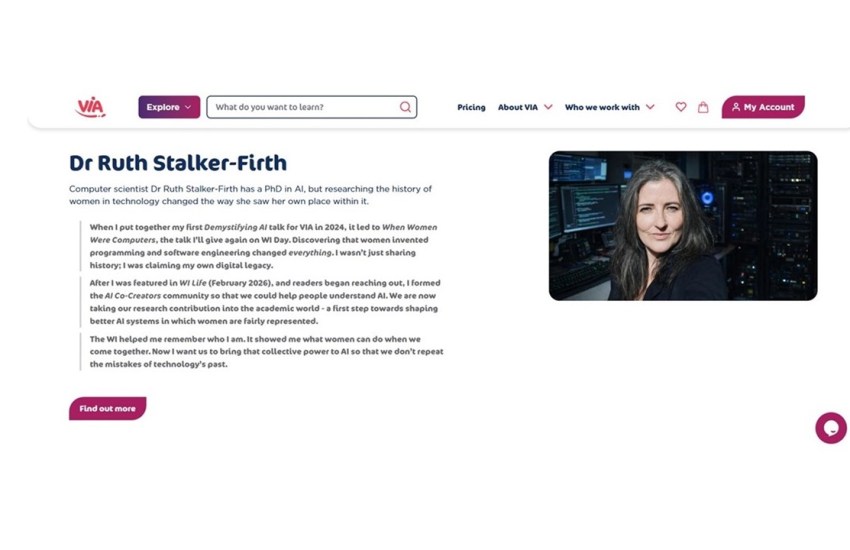
 For the WI’s 111th birthday, or, as Bilbo Baggins called it in The Lord of the Rings, eleventy-first birthday, I’ve been spotlit on VIA, the WI’s online learning hub, on their What We Are Talking About page. I grabbed a screenshot to keep as a souvenir and put it at the top of this blogpost.
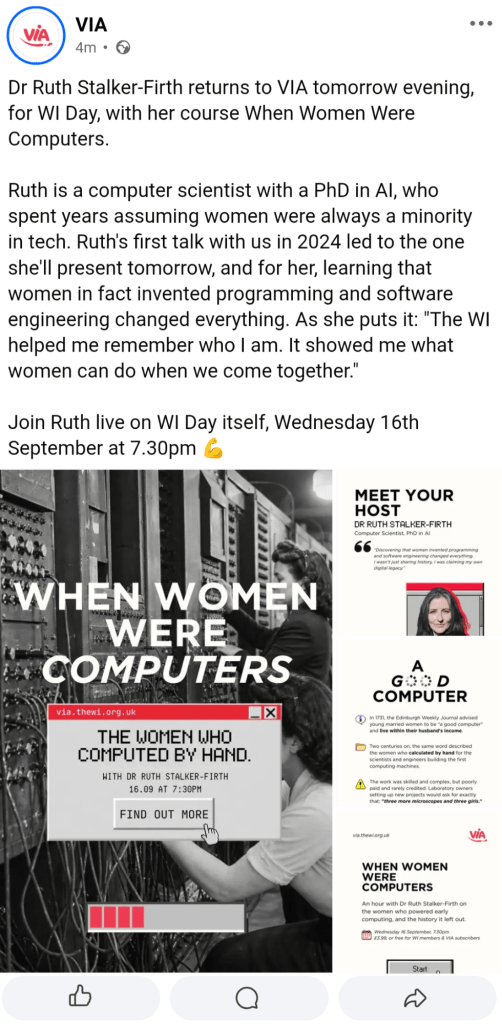
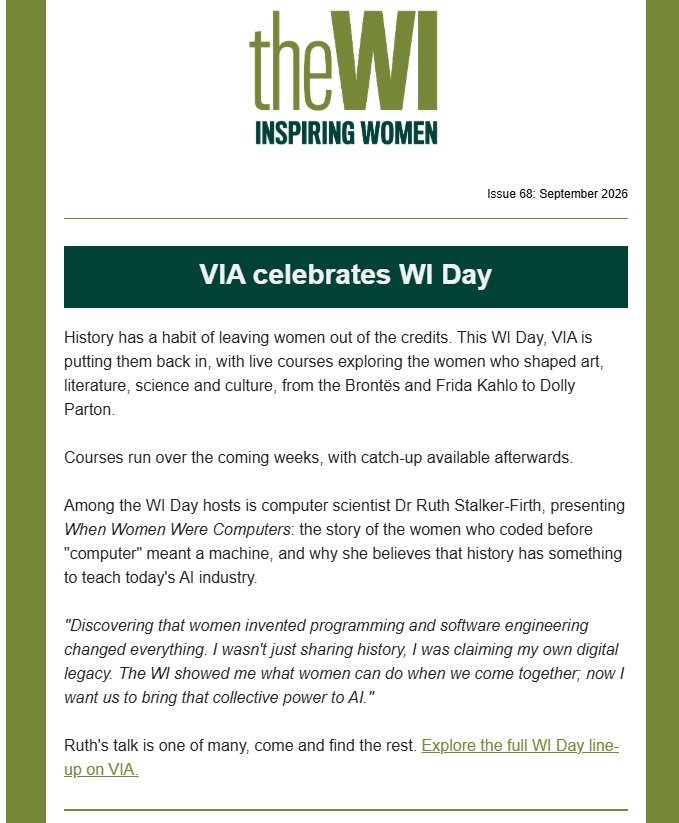
When a VIA team member asked for my perspective ahead of WI Day, I thought about the talk that I would be giving that week called: When women were computers, which I created for VIA and delivered for the first time back in October 2024.
This talk was the direct result of the research that I had felt compelled to do after thinking about how best to present Artificial Intelligence (AI) to an audience who might not have a background in computing. I started from first principles and went on a lovely journey as I gave myself the time and space to ask myself:
Well, how would I describe binary?
Then I was off down memory lane, remembering the labs where as an undergraduate, I played with logic gates, machine code and how assembler mapped onto that. In the end I cut that bit from the talk as I thought that I was getting a bit keen.
It was a great starting point though to imagine myself back in the 1940s and 50s and ask how, from such basic machinery, someone imagined what computers could do.
And do you know how they imagined it?
Ada Lovelace had imagined it a century earlier by looking at the Jacquard Loom even before the first computer was ever built. She was inspired and wrote down how to make programmable machinery. Then once they did build the first computers during WWII, at their heart, ‘manning’ those machines were the original ‘computers’ – women busy creating all the stuff (code, flowcharts, sub-routines, etc.) that made it work.
Because that is what women do.
Women join the dots! They don’t just make the tea and do the typing, they hold up the whole world – broken IT infrastructure included.
Dr Ruth Stalker-Firth
I still have a book from databases in year two of my degree and it has a whole chapter about CODASYL and it doesn’t mention Grace Hopper once – the woman who invented the compiler, nor her role in CODASYL – the first design for a database. Oh and her idea that code should be independent of the computer architecture it runs on. No biggie! Just the whole deal.
I just can’t even imagine how much that might have helped me as a woman to feel that it wasn’t an accident that I had happened to find myself in the field and that I belonged right there. I wasn’t at all the accidental techie I had always believed I was! I had belonged all the time. I was part of the full of history of computing reaching right back to the first women. The women who were computers without whom the field just wouldn’t exist the way it does.
I don’t think anyone did it on purpose, it just never occurred to anyone because of patriarchy that women needed to be attributed. We were just in the background, invisible, making things work, making it look like the systems which were themselves were often broken, worked.
This is doing the field of computing, and women who wish to work there, a huge disservice, but to get us back into that field:
We need to see it to be it.
Me
We need to see us to be us, in that context.
And it not just women in technology, is it?
In a society that pays lip service to diversity and inclusion, but is really rubbish at doing either, it is hard to feel welcome if people who look like you are not represented.
Women make up 51% of the population why are their voices at the tables – where power and technology decisions are made – still in a minority? How can a majority be a minority? The maths is so wrong.
Each time I give this talk, and it is my favourite talk, I am not just sharing history and claiming my own digital legacy, it is also a bit of a call to arms. I want women to know that technology is not some mysterious male territory that we have wandered into late. We have been part of this story from the beginning. We did the things that made it work, that made it useful. We were the beginning and we should be part of the future.
After I was featured in WI Life magazine (February 2026), and women in particular the WI reached out to me, I set up the AI Co-Creators. We ran our first project and will publish the results in an academic journal, because it is time that we were heard and played a role in the future, particularly around AI!
Women need to be at the table when technology is being decided, because the people building it don’t necessarily experience society in all the ways that matter. If they did, perhaps so much of it wouldn’t be so broken.
Dr Ruth Stalker-Firth
I gave a talk on AI last week, in person to a WI where everyone in the room was convinced that AI Armageddon is coming soon. It was in the news – yet more click-bait. I am so sick of the hype and the misinformation and companies telling everyone how powerful they are just before they float their stocks on the market!
If AI is so powerful and create things in seconds, why is the internet full of badly designed web forms? Why are our whole lives full of broken IT? Why hasn’t AI fixed it all then? Because it cannot. That’s why. To fix what is broken we need proper conversations with real solutions. Guess who does that best? Guess who does it all day long without recognition?
Indeed, my latest tangle with terrible IT systems left me ghosted after I applied for a job. I should think I will never hear the outcome from the ‘world-class institution’.
I joined the WI in 2022 because I wanted more female friends and the company of females. In 2023, I started giving talks about AI because it is something I have been thinking about and working with for 30 years and the women I met were curious. I would never have done this without the WI and whilst I am no longer a member (which I have blogged about here) I am so grateful for everything the WI has done for me.
The WI helped me remember who I am. It showed me what women can do when we come together. Now I want us to bring that collective power to AI so that we don’t repeat the mistakes of technology’s past.
As I always say technology is a mirror for society and I do not like the reflection I am currently seeing, not least of all as I don’t see myself in there. I want to change that, with the hope of creating a better world supported by human-centred appropriate technology.
We are looking for funding – so hit me up if you have any ideas. I am working on a couple myself!
Join AI Co-Creators.
Help us shape the future of AI.
We’re telling a new story. The full story. And we’re only at the beginning.