
 Posted by
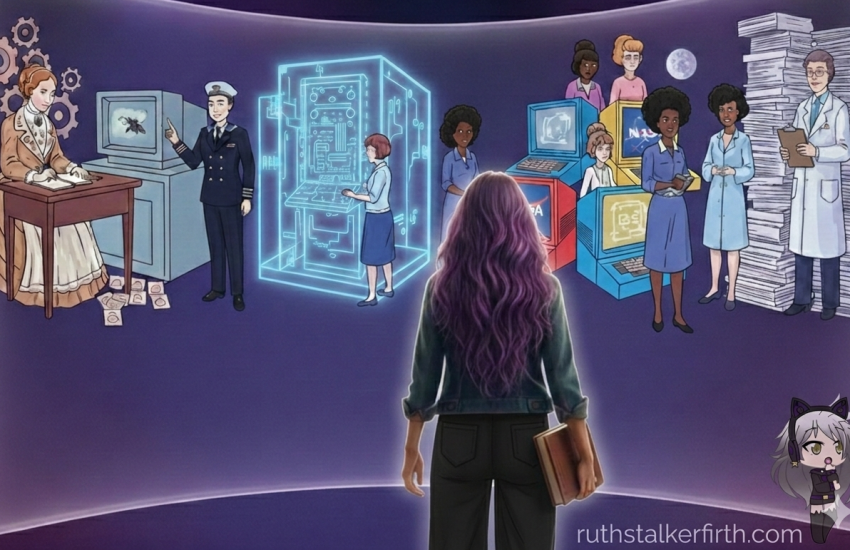
 The other night, I stood in front of 50 women, pointer in hand, slides projected behind me, as I talked about: When computers were women.
I love this talk and have given it a few times now, but this was the first time I had given it in-person. Ultimately, I prefer in-person gatherings as the energy is very different, especially when I am the one doing the talking. I love watching people nod and nudge each other as what I have to say lands with them and resonates. But you know if online is all we have, then I sign me up as I am an eternal student.
Before the talk, I spent time with a lovely new friend whom I met over the weekend at a Fairytale Retreat in Brighton run by the magical Clare Beloved. My new mate picked me up at the station and we got to extend the magic over a pint as the whole retreat had been utter bliss. We had sat in circle all weekend whilst journeying with the stories Bone Woman (La Loba) and Baubo (the cheeky goddess who made Demeter laugh in her grief) and getting massages.
I got to have a massage from the wonderful Jim – Amor Fati Massage Therapy, and when he asked me what sort of massage I wanted, I considered belonging which is something I have blogged about in the past in A place of OKness (December, 2022). Looking at that blog today I see that I have used a picture of the doll I made during Clare’s Fairytale lockdown adventures, (December, 2020) and in a blog I wrote two weeks ago: Blog gazing (February, 2026), I talk about picking over the bones of this blog to reclaim those parts of me I felt I had forgotten.
Ultimately, I asked Jim for a massage that would ground me, as when Clare had asked us to do some art work, and I watched the amazing artists around me create wonderful things, I just drew around my feet, and created my own piece of art that way as my way in. What can I say? I am a computer scientist. That is what I say when I people ask me what I do. I also say that I Demystify AI. I am an educator-practitioner and public speaker.
And, when people tip their head sideways and look at me quizzically and ask me if I am afraid of AI, I say that no I am not, because I have built AI systems, I know how they work. I have a PhD in AI and in 1997, I even represented the country of Switzerland after writing some AI software. The event was in Germany and everyone congratulated me on my excellent English: Where did your learn your English? Even today the idea of a crowd of Germans travelling to Middlesbrough to improve their English speaking skills still fills my heart with joy. You see:
I built AI before it was fashionable and shiny.
Dr Ruth Stalker-Firth
And it was after having a bit of a ding-dong with someone a couple of years ago, when I felt that I had to speak up to correct a load of nonsense about AI taking over the world, who asked me: What do you know about it, Ruth? Well a lot actually, love, a lot.
It was then that I vowed to do two things:
1. Never sit in a circle run by anyone else than Clare (well that lesson took a bit longer, after I got kicked out of Alternatives).
2. To speak up and become someone people can trust, because I know what I am talking about when I talk about AI.
When I started putting together my very first talk on AI, I began at the very beginning: When was the first computer built? What was it built for? What was the original goal of AI? These are things I had never learnt as a undergraduate computer scientist or postgraduate AI student, and the more I looked the more I saw a whole different story from the one I had just assumed. I had assumed since no one bothered to tell me and because I had turned up one of eight women in a class with 90 men and over the years those numbers got smaller and smaller, that women had always been in the minority.
This simply wasn’t true.
It was women who invented the first PC, a woman who had first invented coding, six women who taught themselves to code as the first programmers and then taught everyone else, who invented flow charts and all the tools of the trade to make sure that code was executed in the right order, a woman who had created compilers so that computers spoke English, a woman who had invented software engineering, and women who had put men on the moon.
I could believe it! Why did I not know any of these stories? Why had no one told me? So, I wove them together to make a talk, to make a story, the story of women in computing.
And, this was a story I was so desperate to hear that the first time I told it, I cried.
So, there I was on Monday night on stage, giving this talk. As usual I began with a story of me in typing class, which I had chosen because in the option box there was only typing or computing and I thought that computers had nothing to do with me. But between fighting, typing, Julie Walters and my mam wanting me to better myself rather than working in a factory like her, I ultimately ended up on a different path. My mam also always said that I could cause a row in an empty house (something I have blogged about a few times), which sounded like a bad thing and that I really should keep a low profile – not easy to do when you are the only woman in the room. Older and wiser, I am now thinking it’s a compliment, it takes a lot of energy to create something of out of nothing, it is literally singing over dry bones!
Anyway, as I moved onto Philippa Gregory’s description of the Bayeaux Tapestry, more penises than women, and the first programmer Ada Lovelace who predicted AI writing music, something in me started to change. Now I don’t know if it was a combination of singing over the bones, having Baubo belly laughs at the weekend in circle, and that magical feeling of sitting and chatting with a new friend over a tasty beer by the fireside of a cosy pub, but I felt it. I felt the energy rising full of joy and magic.
I felt it standing on the stage.
And it was then that I realised.
I wasn’t just giving a talk to tell these stories, I was actually talking myself back into history, back into technology, back into belonging. Every woman who listened, and every woman I shared, every challenge they had faced, reminded me that like all the women before me and all the women who will come after me, I have always belonged and I am exactly where I am supposed to be. The words I was weaving, giving and receiving with those lovely women in the audience, were also a conversation I was having with myself. I was naming my history as part of the full history of women, and of technology, I was taking my place amongst the women who were computers.
The two takeaways of the talk are this:
Two things Ruth says all the time!
- You have to see it to be it.
- Women connect the dots as they bring all of themselves to the job and make everything better.
And these are two things you need to work in tech: role models and dot joiners. Currently, there are a lot of badly run IT departments is that they are headed up by people who don’t really know what they are doing and think they are running a DIY shop. I kid you not.
I attended a meeting recently with the head of IT systems for a world leading hospital and he said that he keeps a list of really cool tools and then when someone has a problem he picks one up and gives it to them. WTAF? This is not how you run an organisation which is in need of well designed integrated socio-technical systems to support people in many departments across many disciplines doing really complex things.
And whilst we can get into the politics of gender (which is the topic for another blog), women have been socialised to connect the dots, to make the unworkable workable and to support everyone. And, I say that because I have seen it in real life, I have seen it in the literature, and I give talks about it. The world is in a sorry state right now which is reflected in our terrible technology, as another on of my things that I say is:
Technology is a mirror for society.
also on Ruth’s bingo card of common sayings.
and so to make a better world, we need more women at the technology table so that we can make appropriate decisions on the use of our technology which is currently causing more problems than it solves and AI is just the cherry on the top.
Monday night was a wonderful experience, from the women I met, the talk that I gave, to the way that I felt as I stepped into my digital legacy, and I wish to continue down that path, but I don’t want to do it alone.
I want to design a course for women, but it is not really about gender, it’s about sitting in those warm safe spaces with people who see you, feel you, hear you and could even be you. It’s about the emotional resonance of hearing and being heard, and learning something new without aggression and without the fear of looking foolish. It’s about sharing, connecting and working together to reach a new understanding and to feel better for having spent time together. It’s how I feel in circle with Clare, in the pub with my new friend, and on the stage at Maple Village WI.
The online learning hub Via have said yes to me doing a course on AI but I will also take it elsewhere too, rather like the talks I give, I can create a space, a retreat, if there is a call. If you want me, I am here for you.
And just to show you how not magic, not going to take over the world, and how very much it is just a tool in business AI is, let us consider Google this week. They were complaining about the intellectual property theft of the exact weights on their neural nets – in other words – their algorithmic settings. Hilarious! Google the world biggest data collector, and devourer of all sorts of intellectual property, is complaining about people doing that to them. Watch the six minute video here: Is Google allowed to be mad about this?
If AI really was the self-modifying, self-replicating sci-fi version people – who don’t know anything but still give talks – tell you it is, well then, Google would not be worried about people stealing their secret sauce, would they? AI is not a force beyond our control, it is just a tool, that we created. We really have to stop thinking about it like we do the weather.
So:
Three Questions: What do you need? What do you want to know? How would you like to learn it?
I want to understand what would be truly useful for people. Left to my own devices, I might think everyone needs to code up all their own neural nets with weights so Google can keep their own, but I might be wrong. So far I am thinking non-code and really: What do you need? To this end I have created a questionnaire of three questions.
If that resonates, sign up to so we can co-create an AI course for you to keep —and have a great deal of fun doing it.
So if you think you may want to learn about AI and technology with me, let me know what it is you want to know and how you want to learn it. Your voice will directly shape what I create. Your ideas matter.
I’m thinking that at the end of my course I would like people to say:
- I know what AI can and cannot do.
- I can explain it clearly to others.
- I can use it to create.
All from grounded understanding so that they know enough to know that they totally belong at the technology table, so that they can speak up and add their voice to the discussion about how to use AI for good.
Update August 2026
We did it. We created an AI Learning Journey and I have taught it twice online and am ready to take it on the road.
Check out the AI Co-Creators for future updates or sign up directly to register your interest for learning in-person in an easy safe learning space.