
 Posted by
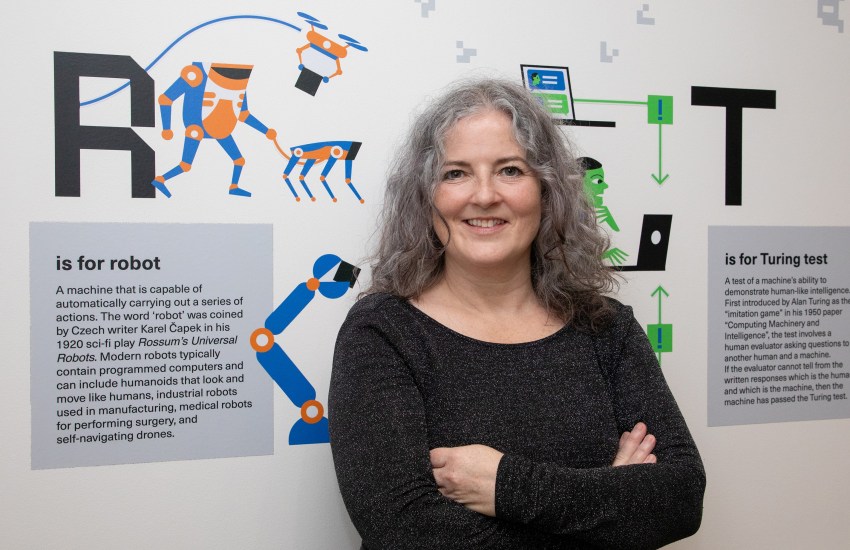
 [Photographs by Kiki Streitberger]
Back in early November, I got an email from the editor of WI Life magazine, asking if I would be willing to be interviewed for a column about the WI Learning Hub, as one of its popular tutors, demystifying AI since 2023. The hub is currently undergoing a rebrand to reflect that it welcomes in all of society. And, VIA goes live on Monday 9th February.
Delighted, I replied and started thinking about which photo to use (my usual) and what I would say. I did this last year for National Women in Science and Engineering Day when asked by the NFWI to share my experiences, thoughts on gender parity and how to encourage more women and girls into STEM fields. We did everything via email and they created some lovely visuals for their social media campaign which I wrote about here: National Women in Science and Engineering Day #MoveTheDial #WISEDay25.
Anyone who knows me knows that it takes me a minute, or indeed a few thousand words to get to my opinion. So, before I emailed the NFWI opinions, I wrote a blog: Women in STEM, women in society, which pulls together a whole raft of research I did: Women: Society, Storytelling, Technology in 2017, and also my own experiences of Fighting, typing and computing, which I wrote in 2024, as I prepped my most popular talk (now complete with video trailer: When women were computers) to find out what I wanted to say. Then I sent them a brief summary. This is my process and it works for me.
Excited by the editor’s email I started thinking about what it means to me to be on VIA demystifying AI. In a nutshell, I think that AI has been touted as the answer to everything when in reality, it takes a lot of code, people, data and electricity and it is highly designed. It does not update itself or modify itself, nor can you train it as an end user. Indeed, AI doesn’t really work as well as the stories would have us believe.
In my talks, I break down exactly how it works and where the stories come from. And, I absolutely love it: AI, it’s achievements and limitations, all whilst keeping it real.
Out of the spam into the feature
A couple of days later, the editor resent the email and I thought: Nooo, I have ended up in her spam. So I rang her up to tell her that I would be delighted as I give talks demystifying AI and I believe that more women should be at the table, because it is women who make software appropriate for society because we bring all of our life experiences. The editor said: Well hold the phone, this is not a column, this a feature. She didn’t really say that as she is very professional but that was the gist.
A couple of weeks later, I spent an afternoon talking to journalist Rin Hamburg and a morning in the British Library with photographer Kiki Streitberger. I had such a great time with both of these lovely women who tried to capture me, my voice, and my personality and shape it into 1500 words and two pictures. That is no easy feat. Especially as Rin said that she would be writing as me. AS ME.
Now as me, someone who has spent nigh on 20 years writing my opinions here, the idea that someone would write as if they were me, made me a bit faint at first and then, very curious as to why I would mind that. I think it comes down to the fact that I have always felt unheard as a woman in society. However, Rin worked really hard to make sure that I felt that she was representing me.
Kiki too spent ages putting me at ease as it turns out I am not comfortable being in the spotlight with a camera trained in my face. Who knew? But she made it so much fun as she took a lot of pictures and kindly sent me them afterwards so I can use them on my website. This is one of my faves: Me and Dr Alan Turing, who despite his genius and contributions to the inception of the field of computing which hastened the end of WWII by two years, was horrifically punished by society for not fitting into the social norms.
We never learn and are currently repeating history, from both the AI perspective, thinking it will solve our problems, to punishing people who do not fit into society’s neat little boxes.
– Dr Ruth Stalker-Firth
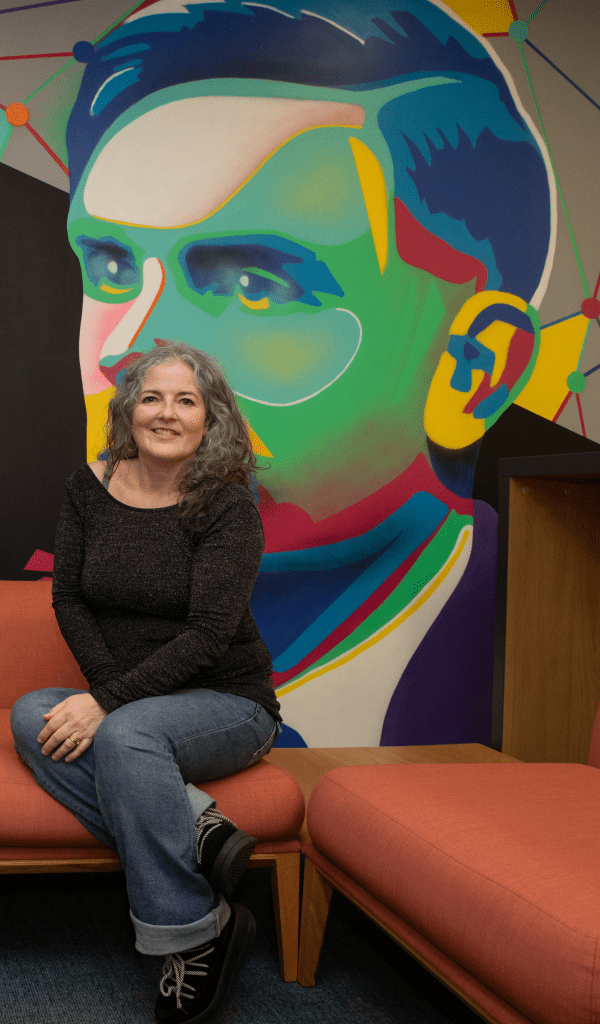
However, from a feminist point of view, Turing was a man of his time and for me the irony of the Turing Test is that it replaces the woman with a computer, saying if someone couldn’t tell the difference between the answer a human gave from a computer then we could conclude that machines think. He borrowed the idea from the BBC Radio program 20 questions which was when someone would try to guess if someone was a man or a woman by asking 20 questions. He did this at a time when women were actually called computers. They did all the grunt work for very little money and no recognition. And, his design of the computer, from which came Von Neumann architecture contained in all our computers, is straight from Turing reading Ada Lovelace’s design notes which he found in the public domain. Women, as always, do the heavy lifting and get written out of history whilst all the men get the legitimacy and the glory. I am glad to get up his nose whilst telling the stories of how women were fundamental to the field of technology as loudly as I can.
Ruth Stalker-Inspiring
After a big wait, the magazine came through my letterbox and I was pleased and flattered to read it. The head of the NFWI gave me a lovely puff on the first page drawing attention to the feature about me as an Inspiring Woman:
Tech guru and AI expert, Dr Ruth Stalker-Firth gives WI Life a fascinating interview on the march of AI and why we should be excited and wary in equal measure. She also argues for more women at the top table in technology or it won’t be built for us. Amen to that.
– Jeryl Stone, NFWI Head
I had a couple of friends say me that they recognised me in the article which is great and I have had some lovely messages from readers across the UK, in particular saying what I wrote chimed with them. On top of which, as women always do, they raised important points about women in society and women in STEM who have many other factors which make them who they are and have a massive impact on their lives, for example, disability, accent, colour, sexuality, gender identity to say nothing of the triple shift which a lot of women are on. All these factors remain unrepresented in the data and have been ignored and often punished throughout history for simply existing. They are examples I will use in futures talks. I also got some great stories from those who have had careers as programmers and just like me began as typists. The article struck a chord and reassured me that what I say resonates.
You can read the whole article here: WI Life magazine Ruth Stalker-Firth.pdf.
And here’s the gist:
Women make up 51% of the population, it is time we had equal say in how our software is designed. For when you create software, you change the way people work, and when you change the way people work, you change society, and that is a political act. We cannot claim that society is diverse and inclusive if our data is missing 51% of the population that includes people of colour, people living with chronic illness, people in wheelchairs, people who did not fit into one binary representation, to name but a few of those who are not represented. It is easier to be it when we see, when we are represented, when we see ourselves in society.
– Dr Ruth Stalker-Firth, WI Life Magazine, Issue 153, February 2026
From interview to ink, and finally film
And finally, for fun, I fed the whole interview into AI (Google’s Notepad LM) to make a 6-minute video, because I can. Not because it’s particularly useful or that it brings anything insightful. Nor did it speed up any thinking or brought any new insight to the table. I did it simply because it was there. And, for me that currently sums up society’s use of AI.
The video is called: Why AI needs a woman’s touch. Of course it is the title, because AI says crappy things like that all the time trained as it is to believe that women are there to keep things tidy, add finishing touches and make the effing dinner whilst flittering about making everyone feel better. Oh my days!
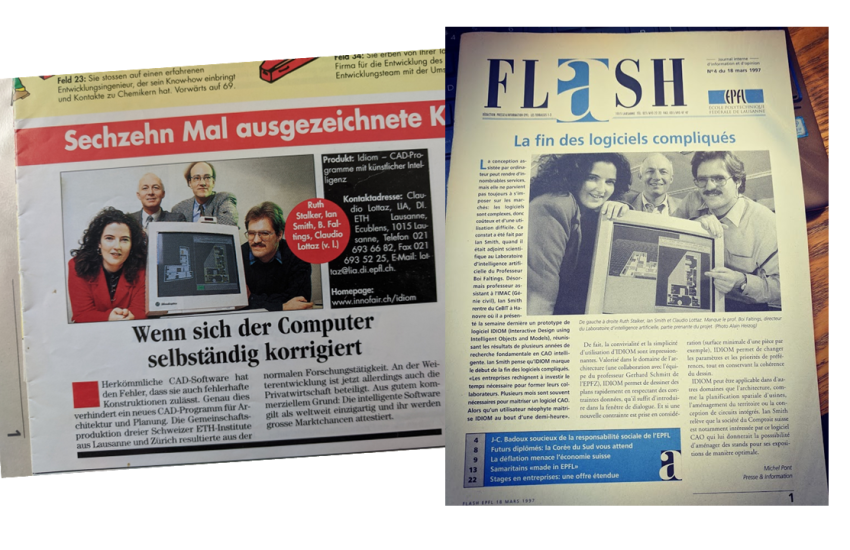
I don’t think I will ever get bored of writing and talking about AI. I started writing here 20 years ago and I’ve been thinking about and programming AI since 1993, and even represented the country of Switzerland for technological innovation with some AI software a colleague and I wrote.
If you would like me to come to your organisation to demystify AI or tell you about when computers were women, let me know via my contact page. I would be delighted.
If you wish to dive deeper into and join a community to create a lovely space in which we can explore and learn about AI, then my AI page is for you. I look forward to working with you and can’t wait for us to get started.